


How to make the most of your visit: when to go underground, where to watch the bats, and practical tips to plan your day.
Carlsbad, New Mexico is best known for what lies beneath: an otherworldly maze of limestone chambers carved by water and time. But if you visit at the right hour, the experience above ground is just as unforgettable. When daylight fades and the desert settles, hundreds of thousands of bats rise out of the cave in a spiraling, sky-filling wave that feels wild and ancient.
I’ve been to Carlsbad Caverns before, but never during bat season. So this September, I made the drive south again through the wide open flats of the Chihuahuan Desert. I wanted to finally experience the evening exodus I’d always heard about. What I found wasn’t loud or dramatic. It was something else entirely: that shared hush when a group of strangers falls quiet, looks up, and remembers why places like this are worth protecting.

Table of Contents
Heads up: Some of the links in this post are affiliate links. If you buy something through them, it helps support this site—at no extra cost to you. I only recommend stuff I genuinely use and trust.
A Short History of Carlsbad, New Mexico
The town was originally called Eddy, named for local entrepreneur Charles Eddy. In 1899 it rebranded itself as Carlsbad, borrowing the name from the famous spa town of Karlsbad (now Karlovy Vary in the Czech Republic) to promote its own mineral springs. Karlsbad was known throughout Europe as a health retreat for royalty and aristocrats, so the name gave this remote desert settlement an instant association with healing waters.
Mining arrived soon after. Potash, then oil and gas, helped drive the local economy and still do today. But the real turning point came when the caverns started gaining attention in the 1920s. As explorers, scientists, and photographers shared what they had seen underground, Carlsbad shifted from a small agricultural outpost to the gateway for one of the most remarkable cave systems in the world.
Today the town still carries its working-class roots, but tourism is never far from view. Whether you’re grabbing breakfast at a roadside diner or waiting for the evening bat program, it’s clear the caverns are still the reason most people come.


The Discovery and History of Carlsbad Caverns
Long before miners or park rangers showed up, Indigenous peoples were aware of the cave openings in these limestone hills. For the Mescalero Apache, the Guadalupe Mountains were a sacred landscape connected to deeper stories of origin and belonging.
The wider world learned of Carlsbad Caverns thanks to a teenage cowboy named Jim White. In the late 1890s he spotted what looked like smoke rising from the desert. Curious, he rode closer and realized it wasn’t smoke at all. It was a column of bats pouring into the sky. Imagine being a teenager on horseback, alone in the desert, and suddenly seeing the sky fill with bats. Most people would’ve stopped right there, but Jim wanted to know where they came from.
Jim returned with a lantern and a homemade ladder, and ventured inside to find rooms so large his light couldn’t reach the walls. He spent years exploring and later guiding early visitors, even taking guano miners underground between shifts. In case you’re wondering, guano is just accumulated bat droppings, but it was valuable fertilizer back then. These weren’t polished ranger tours with interpretive plaques. They were dusty, lantern-lit introductions offered for a few coins and a dose of curiosity.
Carlsbad Caverns became a National Monument in 1923 and a National Park in 1930. The Civilian Conservation Corps later added trails, lighting, and the original visitor center. In 1995, the park earned recognition as a UNESCO World Heritage Site for its geology and scientific value.
Today more than 46,000 acres protect over a hundred known caves. The system keeps growing as new passages are mapped. Every so often, someone squeezes through a tight crack, crawls a few feet farther, and finds another chamber that no human has ever seen. There aren’t many places left where that still happens.

The Bats of Carlsbad Caverns
Each spring, roughly 400,000 Mexican free-tailed bats make the long commute from central Mexico to roost in the caverns’ dark upper reaches. The females pack in shoulder-to-shoulder (or maybe wing-to-wing), each raising a single pup. By early summer the nursery is standing-room only, and by midsummer the ceiling looks like it’s alive — because it is.
These bats are marvels of efficiency. Small enough to fit in your palm (not that many are volunteering their hand), they can reach speeds over 60 miles per hour and eat half their body weight in insects every night. Collectively, they consume tons of moths, beetles, and mosquitoes, serving as a nightly pest-control service that stretches across southern New Mexico and West Texas.
During the warm months, the nightly emergence draws people to the rim of the amphitheater to watch a river of bats spill into the sky. By October, cooler nights signal their departure. The colony funnels south in waves, leaving the cave to its quieter winter residents: cave myotis, Townsend’s big-eared bats, and fringed myotis.

Experiencing the Bat Flight Program
On a September evening, I found myself sitting on the stone benches of the Bat Flight Amphitheater, waiting for dusk along with a few hundred other people. The seating isn’t exactly soft, so there was plenty of shifting and repositioning until the show began.
A few minutes before the ranger started his presentation, people in the back corner rows began leaning over the railing to see what was moving below. A rattlesnake had stretched itself across the warm path beneath the seating area, soaking up the last light of the day. A ranger walked over to keep an eye on it and make sure no one used that route until the snake moved on, a very New Mexico pre-show reminder that the wildlife isn’t limited to the skies.
Once things settled, the ranger stood at the base of the amphitheater, back to the cave, and explained the rules: no photos, no video, no glowing screens. He joked that the bats were still “sipping their morning coffee” before heading out for the night, then invited us into silence. Tonight, we listen.
He asked for a signal. If anyone spotted bats before he did, we should twirl a finger overhead so he’d know to stop talking. We practiced once, a few people laughed, and then the desert settled back into stillness.
He told stories about Jim White and about the bats’ migration, their diet, and their role in agriculture. And then, right on cue, fingers began to circle.
The ranger paused mid-sentence, and everyone was silent.
Out of the cave mouth poured the first wave: hundreds of bats, then thousands, rising into the dusk in a continuous stream.

The sound was low and steady. Just wings, like a soft wind passing overhead.
Then, about 30 seconds later, a sharp wail from a baby cut through the amphitheater. My first reaction was simple and selfish: “Great — I drove hours for quiet, and now I’m going to hear crying instead of wings.” After a minute or two, the ranger stepped over and asked the family to watch from the edge of the seating area so the rest of the crowd could stay focused on the emergence. I don’t think I was the only one who silently thanked him. The bats, of course, never broke rhythm.
People started drifting out after the first 30 minutes or so, but the stream of bats kept coming. I stayed for about 45 minutes, then spoke with the ranger outside of the amphitheater while others remained to watch the full emergence.
He said the timing of the return varies because each bat feeds for a different length of time, depending on how long it takes to catch its fill of insects. Once they’re done, they head back on their own or in small waves, so there’s never a single mass return. Unlike the evening flight, where they circle out in a loose spiral, the trip back is a direct dive straight into the cave. By sunrise, the whole colony is home again.
When I finally headed toward the parking lot, the scene was still quiet — crickets, a few low conversations, and the sound of car doors and engines starting up. From the lot you can’t see the bats anymore. They’re still flying, just too far out in the dark to see.

Visitor Tips for the Bat Flight
- Arrival: In peak season (July and August), arrive 30–45 minutes before sunset to get a seat.
- Seating: The benches are stone, so a small cushion can make the wait more comfortable.
- Electronics: Phones must be turned off for the entire program. No photos, screens, or recording of any kind during the show.
- Temperature: Evenings can cool quickly, so bring a light jacket.
- Timing: Best viewing is from July through early September.
- Silence: The quieter the crowd, the better the experience.
Inside Carlsbad Cavern: What It’s Really Like Underground
Most visitors start their cave experience through the Natural Entrance Trail, a 1¼-mile descent dropping 750 feet below the desert surface. The grade is steady but steep, and the shift in temperature is immediate. The air cools to 56° F and the cave quiet takes over. The walk to the Big Room usually takes 45–60 minutes.

I had a 9:30 a.m. reservation, which was the earliest entry time available. They don’t let everyone in at once. Instead, the ranger takes the first 15–20 people, gives a short briefing, and sends them off before starting the next group. I was in that second small wave. Three of us gradually worked our way past about two dozen people in the first fifteen minutes to break free and enjoy some quiet. The trail is narrow at the start and hikers tend to move slowly, so it took some effort to get around the cluster. Once we were clear of the crowd, the silence settled in and I had long stretches of the descent to myself. That’s exactly what I was hoping for.
Moving at a fast and steady pace, I reached the bottom in just under thirty minutes.
If you are short on time or prefer to skip the hike down, the elevator from the visitor center drops you to the Big Room level in about a minute. It has been operating since 1932 and is still running strong.


The path twists past formations with names as colorful as their shapes, including Devil’s Spring, Totem Pole, and Whale’s Mouth.


After about an hour from the entrance, the tunnel opens into the Big Room, a space so vast it could swallow six football fields.

The loop through the Big Room adds another 1¼ miles and usually takes 60 to 90 minutes, depending on how often you stop to look around. I continued to move at a fast, steady pace due to limited time and finished in about 45 minutes while still pausing for photos. I had long stretches of solitude here too. I stayed ahead of the crowd on purpose so I could hear the cave without the chatter, and ended up walking in near silence for much of the loop. That’s a rare luxury in a place this big.


Deep inside, you’ll find a curiosity few expect: the Underground Café. Open seasonally, it serves simple fare such as soups, sandwiches, and coffee 750 feet below the surface. It is a surreal place to sip hot chocolate beneath stalactites. Even if you don’t stop for a snack, it’s worth walking over for a look. Underground dining is not something you see every day.


Practical Tips for Exploring the Cavern
- Photography: Allowed, but no flash or glowing screens. Tripods require a permit and are not practical for casual visitors.
- Temperature: 56 °F year-round, so bring a light layer.
- Footwear: Wear shoes with traction; the trail can be damp and slick.
- Time: Plan for 2–3 hours to explore comfortably.
- Lighting: Kept low for conservation but still bright enough to navigate without a flashlight.
Hiking and Wildlife Above Ground
Step back into daylight and you’re reminded that the park is more than a cave. Up top, the landscape is simple and spare: yucca, ocotillo, and low desert scrub stretched out under a big sky. You may spot a roadrunner now and then, sprinting between rocks like it’s late for an appointment.
There are several hiking options above ground, and the rangers at the visitor center can point you to a good fit based on time, distance, and how much climbing you want to do. Some trails offer quick plant ID opportunities, others deliver bigger views, and all of them give you a sense of the desert ecosystem that surrounds the cave.
Wildlife shows up in small, subtle moments. Canyon towhees scratching in the dust. Collared lizards sunning on flat rocks. A vulture or two circling overhead to ride the thermals. Go early or late in the day for the best chance of movement. By mid-day, activity tends to slow down as most wildlife slip into shade or shelter once the sun gets high.


Rattlesnake Springs: Oasis in the Desert
It feels like a different world, but it’s still part of Carlsbad Caverns National Park. Rattlesnake Springs Picnic Area sits about 15 miles from the visitor center at the top, a drive that takes roughly 25 minutes. A spring-fed grove of cottonwoods and willows creates a welcome stretch of shade and green in the middle of the desert. It’s a small shift in mileage, but a big shift in feel.
Designated an Important Bird Area, Rattlesnake Springs has more than 330 species recorded, from vermilion flycatchers flashing scarlet to migrating warblers flitting through the canopy.
It’s also a reliable hotspot for dragonflies in summer. In fact, the reason I even knew to come here was because my guide at the Dragonfly Festival at Bitter Lake National Wildlife Refuge recommended it as a good place to look for dragonflies and damselflies. On warm days you can find flame skimmers, blue dashers, and even the occasional green darner patrolling the pond’s edge. Bring binoculars, a camera, and some patience. It’s a place worth lingering.


Final Thoughts
Carlsbad Caverns is worth the time. The cave is impressive, the bat flight is memorable, and Rattlesnake Springs is a solid add-on if you want a quieter place to look for wildlife.
You can do all three in one full day, but spreading it over two makes the experience easier. I arrived for the evening bat flight, stayed overnight in Carlsbad, and then did the morning cave hike followed by Rattlesnake Springs. If you’re staying overnight, I recommend Fiddler’s Inn in Carlsbad (here’s the Hotels.com link for price comparison).
Give yourself a few hours for the cavern, don’t skip the bat program if it’s in season, and plan an hour or two for Rattlesnake Springs, including the drive. It’s a simple, reliable formula for a memorable trip to Carlsbad Caverns National Park.
📚Want to learn more?
If you’d like to dive deeper into Carlsbad Caverns, here are some of the best resources to keep exploring:
- Carlsbad Caverns National Park – Official NPS Site. Trip planning, cave details, bat flight info, and current hours/alerts.
- Carlsbad and Carlsbad Caverns (Images of America) by Donna Blake Birchell. A photo-rich look at the town and the caverns, with solid historical context.
- Carlsbad Caverns: The Story Behind the Scenery by Edward J. Greene. Covers history & geology of the park.
- The Secret Lives Of Bats: My Adventures with the World’s Most Misunderstood Mammals by Merlin Tuttle. My favorite bat book. Tuttle spent decades researching bats around the world, and his first-person stories make it easy to understand how intelligent and important bats really are, not just for the cave experience at Carlsbad, but for ecosystems everywhere.
- Bats: An Illustrated Guide to All Species by Marianne Taylor (photographs by Merlin Tuttle)
Not just a species guide. This one blends bat behavior, ecology, and natural history with Tuttle’s photography. It’s a great way to appreciate the diversity of bats around the world, even if it doesn’t literally cover every species.
Thought for the Week
This week’s “Thought for the Week” comes from Merlin Tuttle, a biologist, conservationist, and one of the world’s leading experts on bats. He started studying bats at the age of twelve and spent decades photographing and documenting their behavior around the world. His work helped change how people think about bats. He later founded Merlin Tuttle’s Bat Conservation, an organization that continues to share research and advocate for bats around the world.
Born in Tennessee and later based in Austin, Texas, his research shifted the conversation from fear to understanding. He has documented fruit bats, nectar-feeding bats, frog-eating bats, and a long list of others. The more you learn, the more you realize bats are a lot more interesting than the old horror-movie stereotypes.
Merlin’s approach is grounded in years of patient fieldwork. And when you sit quietly at the Bat Flight Amphitheater and watch thousands of bats lift into the desert night, his message lands. Fear starts to soften, and curiosity shows up.
Which brings us to this week’s quote:
“We fear most what we understand least.”
— Merlin Tuttle
Thanks for reading and happy travels!
Mark (The New Mexico Travel Guy)
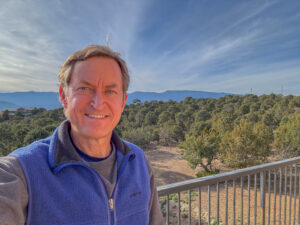
Mark Aspelin, The New Mexico Travel Guy (www.newmexicotravelguy.com), is a travel writer, conservation biologist, project manager, and author of two books. He’s visited over 100 countries and all 50 U.S. states—just enough to land in the Travelers’ Century Club and make choosing a favorite place nearly impossible. He’s currently on a questionable mission to visit every town in New Mexico (there are over 500) and write a story about each one, with plans to wrap it up sometime before his early to mid-100s. Mark balances his writing with conservation and project work from his home base in the East Mountains near Albuquerque, New Mexico.
Leave a reply