


From pit mines to pottery: a weekend with clay artists, One Million Bones, and a stay at Bear Mountain Lodge
Silver City has a habit of luring you in with one promise and sending you home with a suitcase full of side stories. You might show up for the art scene, the mining history, or the trailhead into the Gila Wilderness — but soon find yourself in a conversation you didn’t expect, on a road you never planned to take.
That’s how my summer visit went. I drove down for the Silver City CLAY Festival — a celebration of pottery, sculpture, and all things mud — mostly because it sounded unusual and I knew absolutely nothing about pottery. After the weekend, I still can’t tell you the difference between stoneware and earthenware, but I can tell you about the One Million Bones Project, Bear Mountain Lodge, and a copper mine big enough to swallow a few football stadiums. Just another weekend in Silver City.

Table of Contents
Heads up: Some of the links in this post are affiliate links. If you buy something through them, it helps support this site—at no extra cost to you. I only recommend stuff I genuinely use and trust.
Silver City’s roots go deeper than its name suggests — and not just because of the silver
Long before prospectors arrived, the region was home to the Mimbres people, part of the larger Mogollon culture. From roughly 200 CE to 1150 CE, they farmed along the rivers and created some of the most distinctive pottery in North America — black-on-white bowls with geometric patterns, wildlife, and human figures. Many have been found in nearby ruins and burial sites and are now housed at the Western New Mexico University Museum.
Spanish explorers arrived in the 1500s, drawn by tales of turquoise and copper. But it wasn’t until the 1854 Gadsden Purchase brought this corner of New Mexico into U.S. territory that miners, merchants, and a town bearing the name “Silver City” took root. It wasn’t an easy start; Apache raids and mining disputes made those early years as volatile as the dynamite used to blast its ore.
Silver was discovered in 1870, and just like that, a boomtown was born. The population surged. Prospectors staked claims. Merchants followed. Silver City soon had a main street, saloons, hotels, newspapers — even its own opera house. By the 1880s, it boasted streetlights, telephones, and an odd dishwasher named Henry McCarty — later known as Billy the Kid.
But rapid growth brought rapid problems. Chief among them? Flooding.
Built in a valley stripped bare by mining, logging, and overgrazing, Silver City had no natural buffer when the summer monsoons arrived. In 1895, a massive flood carved a gully down Main Street, ripping up buildings and infrastructure in its path.
More floods followed, cutting deeper with each decade. Eventually, it became clear the street couldn’t be saved. New roads were built along the rim of what had once been the commercial center.
What remained became The Big Ditch — a deep arroyo lined with stone walls, stairways, and footbridges. Today, it’s a park shaded by cottonwoods, dotted with public art and historical markers. In a town shaped by erosion, the ditch is no longer a disaster. It’s a feature. Only in New Mexico could a collapsed Main Street turn into a community gathering space — and feel like a win.


Of course, Silver City’s story isn’t just about what happened downtown. Sometimes, you have to step outside the city limits to find the next chapter. Enter Bear Mountain Lodge.

Bear Mountain Lodge: Art, History, and a Field of Bones
Just five miles outside of Silver City, Bear Mountain Lodge is tucked into a piñon–juniper landscape that rolls right up to the edge of the Gila National Forest. It’s quiet here — the kind of quiet that makes you realize how loud your life normally is.
But Bear Mountain Lodge hasn’t always been a nature retreat.
The original stone buildings date back to 1928, when this was the Rocky Mountain Ranch School, a private boarding school for “pre-adolescent boys with psychopathic tendencies.” Yes, that’s how they described it in the brochures. Despite the impressive marketing pitch, the school didn’t last long. It closed during the Great Depression, but the architecture endured.
Over the decades, the property morphed into a country club, a dude ranch, and eventually a family-run lodge. In 1972, Myra McCormick and her family took over, and Myra ran the place for more than 40 years — hosting guests, guiding birders (she was an avid one), and becoming a fixture in the local community. When she passed, she donated the land to The Nature Conservancy, with the stipulation that they keep operating her guest ranch for at least 10 years after her death.
The Nature Conservancy kept its promise. In 2000, they restored the buildings and protected the surrounding 178 acres. After fulfilling their 10-year commitment, they sold the property to the current owners, Linda Brewer and Harry Stringer, who continue to run the lodge with a conservation ethic that reflects both the land’s legacy and their own values.
But the lodge isn’t just about quiet moments of reflection — though you’ll find plenty of those. It also hosts seasonal retreats, workshops, and art shows, many tied to the land or local culture. The Blue Dome Gallery features rotating exhibits from regional artists — pottery, painting, photography, sculpture — much of it for sale.
For guests, there are more than five miles of trails right on the property. They’re well-marked and easy to follow, offering a mix of overlooks and wildlife sightings. Birders will have a field day (literally), but even casual hikers will enjoy spotting mule deer, javelina, lizards, and hawks.
And when you’re done, the main lodge is waiting with breakfast or a seat on the patio looking out at Turtle Rock and the surrounding mountains.
Whether you’re here for the art, the trails, or just a quiet night under the Gila sky, Bear Mountain Lodge makes a strong case for lingering in Silver City a little longer.
Here’s a link to the Bear Mountain Lodge website and a link to Bear Mountain Lodge on hotels.com in case you’re price shopping.


From Washington, D.C. to Silver City: The Story of One Million Bones
Speaking of art, while scanning the CLAY Festival schedule I spotted something intriguing: a “Bone Making” workshop. Ninety minutes, free, and held at Bear Mountain Lodge — where I just happened to be staying. That pretty much wiped out all my excuses, so I signed up.
It turned out to be a very exclusive event — if by “exclusive” you mean just me, one other participant, and the instructor, Linda. She seemed to know an awful lot about Bear Mountain Lodge, so I asked if she was a manager. Not quite — she’s the owner. Off to a great start.
Linda’s husband had told me beforehand to think about which human bone I might want to make out of clay. Reaching into the cobwebbed corners of my memory from two long-ago human anatomy courses, I settled on the hyoid — a small, underappreciated bone in the throat that helps us speak. It seemed fitting to have a hyoid “speak” to the genocides of years past. Plus, hardly anyone knows where it’s located, let alone what it’s supposed to look like, so I figured I had creative license to mangle it without shame.
When I finally declared my hyoid ‘done’ — and by ‘done’ I mean it looked like a mouthguard for a large cow — I still had a lump of clay left on the table. Linda suggested I make another bone. Darn. This time I went with the humerus, the long bone in the upper arm, figuring it couldn’t turn out much worse than the hyoid. It probably did. But by then it didn’t matter — the three of us were deep into a fun conversation about New Mexico and Bear Mountain Lodge, and the clay had become more of a sideshow than the main event.


Before we started shaping lumpy bones and swapping stories, the obvious question came up: what exactly were these bones for? That’s when Linda told us about the One Million Bones project — a large-scale collaborative art installation and social action campaign that used handcrafted ceramic bones as symbols of remembrance for victims of genocide and mass violence.
The project began with artist and activist Naomi Natale, who believed art could do more than decorate walls — it could educate, provoke, and move people to act. Her idea was simple but bold: invite people from all walks of life to create symbolic human bones, then gather them together in one massive, visible display. Each bone would stand in for a life lost and serve as a call to remember, learn, and respond.
The project’s most visible moment came June 8–10, 2013, when more than a million handmade bones were laid out on the National Mall in Washington, D.C., forming a sea of white clay that resembled a mass grave. It made headlines, but its real power was in the lead-up — classrooms learning about Rwanda and Sudan, people of all ages shaping clay into something that mattered, and stories being shared that might not have been told otherwise.

Once the D.C. installation ended, the bones were stored, with some finding new homes in partner communities. Today, only two permanent sites exist: one at the Srebrenica-Potočari Memorial Center in Bosnia and Herzegovina, and one here in Silver City at Bear Mountain Lodge. In April 2018, bones from the original run were placed in a meadow behind the lodge, where the project continues as a living installation. Guests can still make new bones, have them fired, and either place them on a return visit or carry someone else’s creation into the landscape.
Naturally, I wanted to see the meadow for myself. Linda pointed me toward the “bone pile” — a stack of fired bones waiting to be carried — and suggested I grab a backpack for the two-mile round trip. My freshly made hyoid and humerus stayed behind to be fired, so I loaded up with bones made by others and headed down the trail, curious to see how they would look arranged across the land.

Along the way, I spotted a few bones serving as cairns — a reassuring sign I was still on the right trail. About a mile in, something stretched across the path. At first I figured it was a stick, but then I noticed the faint striping — a whipsnake, perfectly still, betting on the old “if I don’t move, maybe they won’t notice me” strategy. I snapped a few photos, gave it the right of way, and stepped off the trail so it could keep soaking up the sun.


Not long after, the trees opened up and the meadow came into view. There was no mistaking I’d arrived.
The trail spilled into a sunlit clearing carpeted with thousands of bones, scattered across the ground and framed by the surrounding pinyon-juniper woodland. No people, no sound beyond the wind and a few birds — which, of course, I couldn’t resist identifying. It was quiet, thought-provoking, and well worth the visit.


I’m used to quiet and beautiful — it’s my normal at home. What made this different were the bones. The closest thing I’ve seen was the Hill of Crosses in Lithuania, a hillside covered with an estimated 200,000 crosses and crucifixes. That site has a long history and became a symbol of resistance during the Soviet occupation. Different medium, different history — but the same sense of standing in a place layered with meaning, where every object was placed with intention.
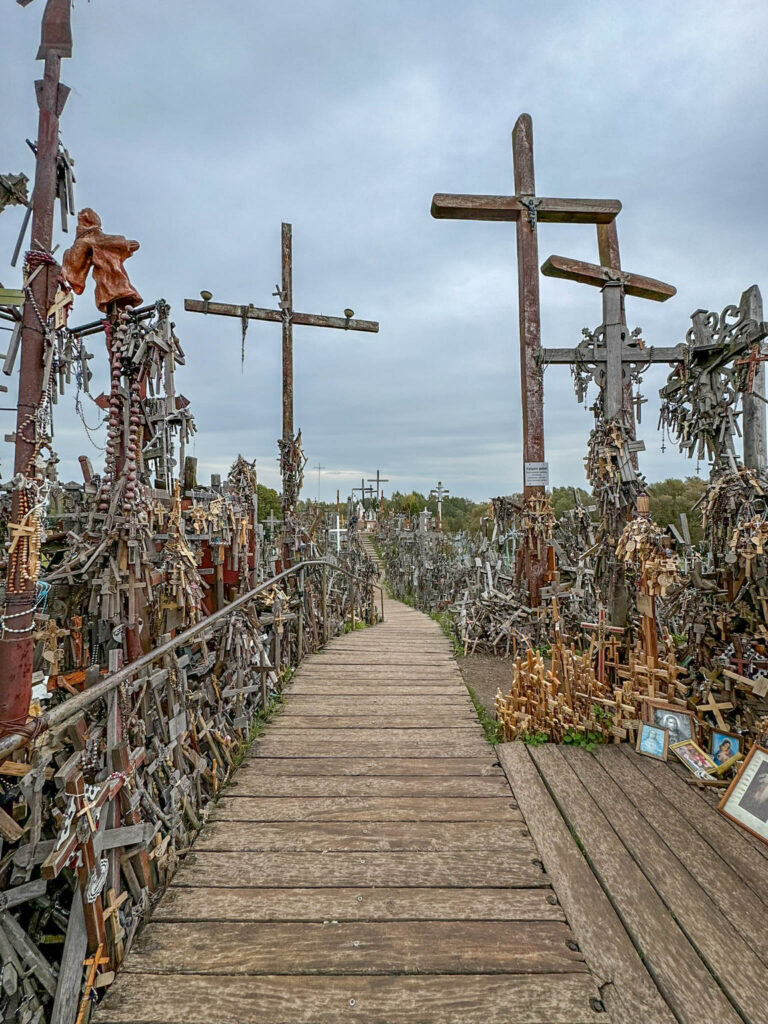
Like the Hill of Crosses, the One Million Bones meadow is a reminder — quiet but impossible to ignore — of lives lost and the importance of remembering. And here at Bear Mountain Lodge, that reminder is woven into the landscape itself, waiting for the next set of hands to add to its story.

CLAY Festival: Mud, Fire, and Community
The Silver City CLAY Festival is a weeklong celebration of all things clay — from handmade pottery and adobe architecture to ancient ceramics and modern sculpture. Running for over a decade, it draws a mix of artists, educators, historians, and curious travelers. But don’t picture throngs of people crammed into streets or booths stretching for miles. This isn’t Santa Fe or Albuquerque. It’s Silver City — slower, smaller, more personal.
This year’s festival featured exhibits, artist talks, and workshops, along with the CLAY Market — a temporary marketplace inside the Murray Hotel where ceramic artists and other artisans displayed their work. The scale wasn’t overwhelming, but the variety was impressive: rugged wood-fired mugs, delicate porcelain vases, and earthy, functional ware.
One of the real perks of the festival’s size is access. You can chat with artists about their process without feeling like you’re holding up a line. Curious about glazes, kilns, or how they got started? Ask away. The conversations are as much a part of the experience as the art itself.
Beyond the market, the schedule included lectures on archaeology, hands-on clay workshops, and exhibitions scattered across Silver City’s galleries and cultural spaces. If you’re into pottery, archaeology, or simply enjoy tactile art and quiet creativity, the CLAY Festival is worth planning around. It’s a hands-on reminder that clay isn’t just about what you make — it’s about the connections you form in the process.
👉 More info: clayfestival.com


Arabian Horses, Silver City Style
Clay wasn’t the only form of artistry I stumbled across in Silver City. Just outside of town, I spent some time around Arabian horses at Foothills Arabians. If you’ve ever seen one up close, you know why people call them living sculptures — all arched necks, expressive eyes, and enough spirit to remind you that “elegant” doesn’t necessarily mean “tame.” The ranch has some history too: the owners have been breeding purebred Arabians here since the 1970s, drawing inspiration from Sheila Varian — a legendary California breeder known for horses that combined beauty, athleticism, and good temperament. Today, Foothills Arabians continues that tradition just outside downtown Silver City, and the ranch welcomes visitors who want to stop by and take a look for themselves.


Santa Rita (Chino) Mine: Copper, Community, and a Hole in the Earth
About 15 miles east of Silver City, the road comes over a ridge and suddenly the land drops away into something almost otherworldly — a terraced crater more than a mile across and 1,500 feet deep. This is the Santa Rita Mine, better known today as the Chino Mine. It’s one of the oldest and largest open-pit copper mines in the world, and for better or worse, its story is forged into the history and identity of this corner of New Mexico.


A Brief History
People have been pulling rock out of these hills for centuries. Long before heavy machinery arrived, Indigenous peoples extracted turquoise here. In the early 1800s, Spanish colonists began mining copper at a place they called Santa Rita del Cobre — Saint Rita of the Copper. That small settlement grew into one of the Southwest’s first major mining operations.
Industrial mining took hold in the late 1800s, and by the early 20th century, underground shafts gave way to large-scale open-pit methods. From there, the hole just kept getting bigger. Today, the pit stretches over 1.5 miles wide and produces copper by the hundreds of millions of pounds each year — the same copper that runs through our phones, laptops, cars, and power grids.
Modern Operations
The mine is now operated by Freeport-McMoRan, one of the world’s largest copper producers. Beyond copper, the operation provides hundreds of jobs in Grant County, contributes tax revenue, and helps support schools, infrastructure, and community programs. For many families, the mine isn’t just a paycheck — it’s a legacy, with multiple generations having worked the site.

The Town That Disappeared
The town of Santa Rita grew up alongside the mine in the early 1800s, eventually becoming a full-fledged company town with homes, churches, schools, and shops. But as the pit expanded, the town had to move. And then move again. By 1967, the final residents were relocated, and the town itself was bulldozed to make way for copper. Today, Santa Rita exists only in memory — swallowed by the mine it once supported.
Mixed Views from the Community
Talk to folks in Silver City or Bayard, and you’ll hear both pride and unease. For many, the Chino Mine means stability: good wages, healthcare benefits, and the chance to stay close to home. Freeport-McMoRan’s Community Investment Fund has also poured money into local schools, nonprofits, and STEM education.
But there’s another side. Concerns about dust, air quality, water use, and massive tailings piles are never far from the conversation. While the mine follows state and federal regulations, some residents believe oversight doesn’t go far enough or fast enough. And looming over everything is the question of “what’s next?” The copper won’t last forever. Some argue the region leans too heavily on a single industry and needs to diversify before the mine winds down for good.
In short, the Chino Mine isn’t universally loved or condemned. It’s complicated — a place where pride, livelihood, and identity intersect with questions about the land and what comes next.

Final Thoughts
Silver City is a town of contrasts — where deep history meets modern creativity, and where art, geology, and memory overlap in surprising ways.
In just two days, I shaped clay, stood at the edge of a mile-wide mine, said hello to a few Arabian horses, and wandered landscapes that have been shaping human lives for centuries.
Silver City is a town of contrasts — and that’s exactly why I’ll be back.
📚Want to Dig Deeper?
If you’re curious to explore more about the themes in this post — from ceramics and kintsugi to mining and the natural history of the Southwest — here are a few books that might be worth a look. (Affiliate links included.)
Ceramics in America (Annual series, Chipstone Foundation)
This long-running series is known for digging into the cultural and historical side of ceramics — everything from old kiln sites to profiles of contemporary artists. I haven’t read it myself, but it looks like a solid resource if you’re into pottery’s backstory.
Kintsugi: Finding Strength in Imperfection by Céline Santini
This one’s more about the mindset than the glue. It uses the Japanese art of repairing broken pottery with gold as a way to think about resilience, healing, and not pretending the cracks were never there. It’s simple, not preachy, and worth flipping through if you’ve been feeling a little chipped lately.
Wild New World: The Epic Story of Animals and People in America by Dan Flores
A sweeping environmental history of North America through the lens of wildlife and human impact — from mammoths and dire wolves to modern conservation efforts. Flores, a New Mexico-based writer, weaves in stories from our own backyard (including the Gila and surrounding region), placing the Southwest at the heart of the continent’s ecological transformation.
Gila: The Life and Death of an American River by Gregory McNamee
An engaging blend of natural history and regional storytelling, this book follows the Gila River from its origins in the mountains of southwestern New Mexico through Arizona, tracing its ecological and cultural significance across centuries. McNamee explores the river’s role in shaping Indigenous life, colonization, mining, and modern conservation challenges — all with an eye toward what’s been lost, and what might still be restored.
Thought for the Week
Kazuaki Tanahashi is a Japanese calligrapher, translator, and Zen teacher. He’s best known for bringing the writings of Dōgen — a 13th-century Zen master — to English-speaking audiences. But beyond his scholarly work, Tanahashi is drawn to imperfection. His art often explores the beauty found in what’s cracked, crooked, or incomplete.
That idea is at the heart of kintsugi — the Japanese tradition of repairing broken pottery with gold. Instead of hiding the damage, the cracks are filled and highlighted. The break becomes part of the story. In fact, it’s often the part that gives the piece its character.
It’s a different way of looking at things — not just as fixed or broken, but as evolving. Changed, yes. But still whole.
That mindset reminded me of Silver City. A town shaped by mining, flooding, erosion, and reinvention. A place where clay becomes art, bones become symbols, and even a collapsed Main Street becomes a park. It doesn’t erase the cracks. It works with them.
“The true life of the bowl began the moment it was dropped.”
— Kazuaki Tanahashi
Thanks for reading and happy travels!
Mark (The New Mexico Travel Guy)

Mark Aspelin, The New Mexico Travel Guy (www.newmexicotravelguy.com), is a travel writer, conservation biologist, project manager, and author of two books. He’s visited over 100 countries and all 50 U.S. states—just enough to land in the Travelers’ Century Club and make choosing a favorite place nearly impossible. He’s currently on a questionable mission to visit every town in New Mexico (there are over 500) and write a story about each one, with plans to wrap it up sometime before his early to mid-100s. Mark balances his writing with conservation and project work from his home base in the East Mountains near Albuquerque, New Mexico.

Thanks for the great photos and tour. This is a magical place
Thanks, Steve! I agree, Silver City is well worth a visit.