

A historic mining town along the Turquoise Trail, with Old West film history, local turquoise, and an unexpected art exhibit.
Updated April 2026
Cerrillos is easy to miss if you’re driving the Turquoise Trail between Albuquerque and Santa Fe. It’s the kind of place you assume you’ll stop at some point, but somehow never do. I’ve driven past it more times than I can count.
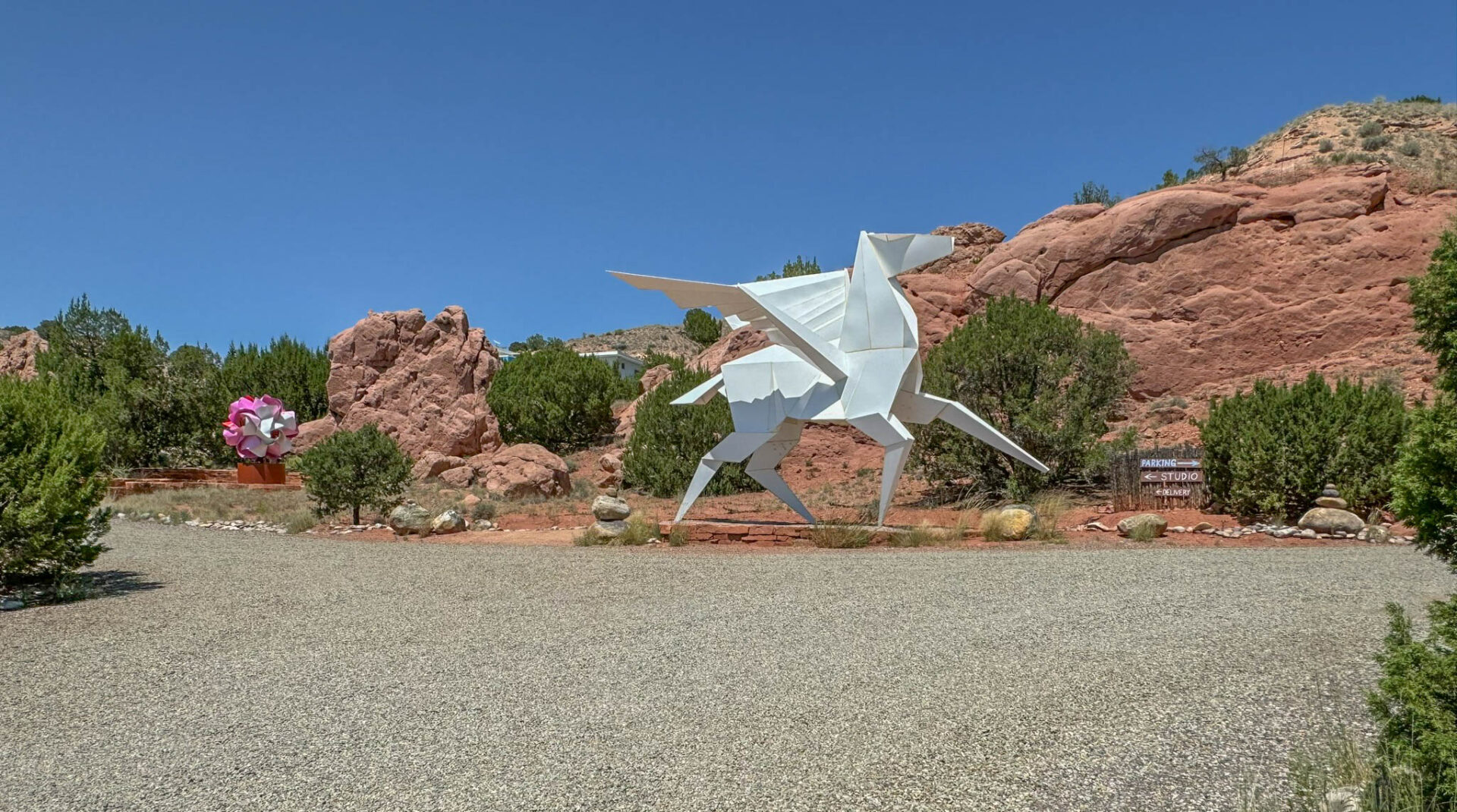
Just past Madrid, though, there’s something a lot harder to ignore. Large-scale origami sculptures rise up from the desert along Highway 14, marking the entrance to Origami in the Garden. It’s not what you expect to see out here, unless you regularly expect to find giant origami sculptures in the middle of the desert, in which case I have several questions.
At some point, curiosity got the better of me and I finally pulled over to see what was actually back there. Since I was already in the neighborhood, I figured I might as well stop in Cerrillos too.
What I found was a small town that still feels tied to its mining past, along with an unexpected connection to films like Young Guns. Together with Origami in the Garden just up the road, it makes for a stop that feels a little different from everything else along the Turquoise Trail.
Here’s what you’ll find if you stop.


Table of Contents
Heads up: Some of the links in this post are affiliate links. If you buy something through them, it helps support this site, at no extra cost to you. I only recommend stuff I genuinely use and trust.
A Brief History of Cerillos, New Mexico
Located about 30 minutes south of Santa Fe along Highway 14, Cerrillos (also known as Los Cerrillos) is a small town with a surprisingly rich history. The area was originally inhabited by Native American communities, including the Keres and Tewa, who mined turquoise from the surrounding hills. That turquoise was highly valued and traded across the Southwest and beyond.
Some of the oldest mines in North America are found in the Cerrillos Hills, with evidence of mining activity dating back more than a thousand years. Pueblo communities used turquoise for rituals and medicinal purposes, and also mined galena (lead sulfide) as a pigment for decorating pottery.
In the 1580s, Europeans “discovered” silver in the galena ore found in the Cerrillos Hills. About a century later, in 1695, a small silver and lead mining camp was established and named El Real de los Cerrillos. The name “cerrillos” roughly translates to “little hills,” which fits the landscape. It can also mean things like “taper candle” or “match,” which feels like the wrong direction in a place known for dry, fire-prone hills. So we’ll stick with “little hills” and sleep easier. Either way, the camp only lasted about a year, but it marked the first recorded use of the name Cerrillos.
The real boom didn’t come until 1879, when gold was discovered in the Cerrillos Hills by two miners from Leadville, Colorado. News spread quickly, and by the mid-1880s, Los Cerrillos had grown into a busy mining town with nearly 3,000 residents. At its peak, it supported 21 saloons, four hotels, five brothels, and several newspapers. For a time, Cerrillos was even considered as a possible capital of New Mexico.
The boom didn’t last. By 1929, major mining operations had shut down and the population declined. Today, Cerrillos is home to about 250 residents. Small-scale mining still continues through private claims and hobbyists, and the hills remain one of New Mexico’s better-known sources of turquoise.

Cerrillos as an American Old West Movie Set
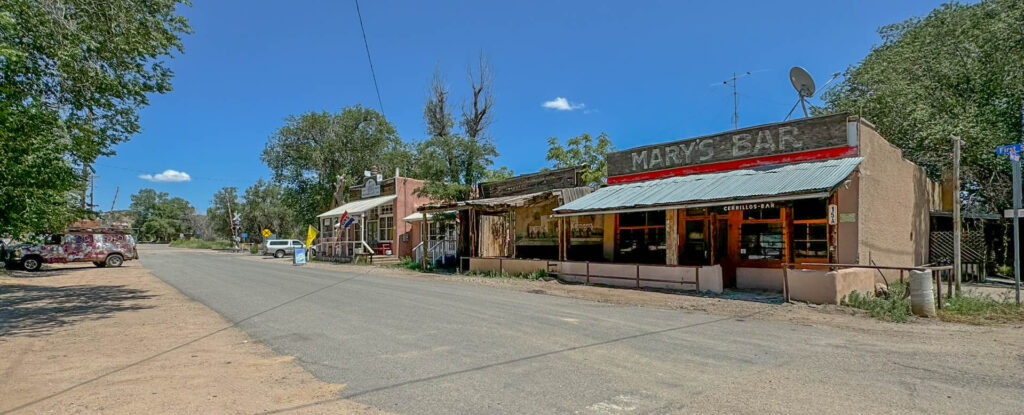
The dirt roads and weathered buildings in Cerrillos look like they belong in an Old West movie, which is probably why the town has been used in more than a dozen films, including “Young Guns” (1988). Young Guns stars Emilio Estevez as Billy the Kid, along with Kiefer Sutherland, Lou Diamond Phillips, and Charlie Sheen. It’s one of those casts where everyone looks familiar, even if you can’t quite place them.
Young Guns follows Billy the Kid during the Lincoln County War, a storyline that shows up often in New Mexico history. At some point, just about every town in New Mexico finds a way to work Billy the Kid into the story. Nearby Lincoln ramps things up exponentially with Old Lincoln Days and its “Billy the Kid Pageant.” I covered that in a separate post about Lincoln, New Mexico.
If you’ve seen Young Guns, some of the setting will feel familiar. Cerrillos doesn’t need much set dressing. It already looks the part.


Cerrillos Attractions
Cerrillos isn’t big, but there’s enough here to make it worth a stop. Until recently, Cerrillos Station served as a central hub, with gifts, groceries, and a community space that included a dance studio and a Thursday farmers market. The store closed in July 2025, although the farmers market and nearby businesses continue to operate.
Beyond that, you’ll find a handful of small shops, galleries, bars, restaurants, and a post office. For a full list of businesses and historic buildings, the Cerrillos community website is a helpful resource.
A few other spots worth checking out, in addition to Origami in the Garden, include St. Joseph’s Catholic Church, Casa Grande Trading Post, Cerrillos Turquoise Mining Museum, the Cerrillos Petting Zoo, and Cerrillos Hills State Park.


St. Joseph’s Catholic Church
The first St. Joseph’s Church was built in the 1880s and later replaced by the current structure in 1922, toward the end of the town’s mining era. Today, it’s part of the Archdiocese of Santa Fe, with Mass held Tuesday through Friday at 8:30 a.m. and on Sunday at 9 a.m.
Out front, there’s a single wood carving of a figure in a red robe with arms raised. I’m assuming it’s St. Joseph, but I wouldn’t bet on it. Either way, it’s hard to miss and gives the place a bit of character. There’s also a small shrine off to the side with additional wood carvings that are easy to overlook if you’re just passing through.


Casa Grande Trading Post, Cerrillos Turquoise Mining Museum, and Cerrillos Petting Zoo
If you’re looking for a quick way to get a feel for Cerrillos, the Casa Grande Trading Post is a good place to start. Since 1975, the Brown family has run this long-standing, family-owned spot.
Inside, you’ll find the Cerrillos Turquoise Mining Museum ($4 entry), with artifacts and displays that highlight the town’s mining history. If museums aren’t your thing, there’s also a small petting zoo where you can feed animals like a llama, goats, and chickens for a small donation.
I’m usually all in for petting zoos, jostling with the children to get a good spot, but when I stopped by it was mid-day on a hot afternoon, and the animals were more interested in the shade than anything else. If I’d brought food, I probably would’ve had better luck.
The Casa Grande Trading Post itself is worth a look, with handcrafted items including turquoise jewelry from the Brown family’s Little Chalchihuitl mine claim, along with rocks, minerals, pottery, and other local goods. As they put it, “We mine it, we make it, and we sell it.”
While I didn’t make it through the museum or the petting zoo, I left with a piece of turquoise and called it a success.


Cerrillos Hills State Park
Cerrillos Hills State Park is just outside town and offers about five miles of trails for hiking, along with options for mountain biking, horseback riding, and picnicking. It’s open year-round for day use from sunrise to sunset, with occasional educational and nature programs throughout the year.
I didn’t have a chance to explore the park this time, but it’s an easy add-on if you’re already planning to stop in Cerrillos. If you’re interested, the Amigos de Cerrillos Hills State Park website and the New Mexico State Parks website have more details.


Origami in the Garden
About five minutes north of Cerrillos’ historic district, you’ll find something completely different. Large-scale sculptures inspired by the art of origami rise up from the desert. It’s not what you expect to see out here, which is probably why it’s so hard to ignore from the road.
As a “craniac” who used to raise endangered crane species at the International Crane Foundation, I’ve seen my share of origami cranes. I’ve also read that “origami” means “folded paper” in Japanese. But that’s about the extent of my knowledge of the art of origami. In other words, I’m a rube when it comes to that subject. So, I decided to use my visit to Origami in the Garden as an opportunity to learn more about this fascinating art form.
After parking, I walked around the outdoor exhibits, then went into the visitor center to look around and ask a few questions. One of the staff mentioned a documentary about the site and the artists, so I ended up watching Origami in the Garden: The Film later that day. It helped me appreciate how much work went into turning Origami in the Garden into a reality.
Here’s a closer look at the sculptures and a few takeaways from the film.

Walking the grounds of Origami in the Garden in Cerrillos
I walked the grounds and stopped at most of the sculptures, taking time to read the descriptions and get a better sense of what each piece was trying to convey.
Here’s how Santa Fe artist Kevin Box, who founded Origami in the Garden, describes his work:
“Origami animals, paper airplanes, crumpled ideas and innovative abstraction are all themes that inform the surface of my work. Every piece has a title, a reason, and a purpose in contributing to the story I am telling beneath the surface. Motivating the content of the work are my concepts of truth, my philosophy of chaos and consciousness, creation and evolution, the process of creativity and our relationships and responsibilities to one another.”


Visitor Center at Origami in the Garden
After exploring the outdoor exhibits, I stepped inside the visitor center to check out the “Inside Out” folding and unfolding display. I also spent a few minutes browsing the gallery gift shop.
The indoor exhibits focus on how the sculptures are created, including pieces that show both the folded form and what the original sheet of paper looks like when it’s unfolded. It’s a simple idea, but seeing the “before and after” side by side makes it easier to understand what you were looking at outside.
You’ll also find smaller versions of some of the sculptures on display, along with books, paper, and a few items for sale, including T-shirts and artwork. It’s not a big space, but it adds a layer you’d probably miss if you just walked the grounds and left.


Planning Your Visit to Origami in the Garden (2026 Update)
Origami in the Garden, also known as the Box Studio Sculpture Garden, is located just off Highway 14 in Cerrillos. It’s open weekdays from May through October, with hours generally running in the morning to early afternoon depending on the time of year. It’s an easy, worthwhile stop if you’re already driving the Turquoise Trail.
There’s a suggested donation of $10 per person, and kids 16 and under are free. The site also opens for select weekends and special events throughout the year, including the Turquoise Trail Studio Tour and Balloon Fiesta weekends.
A few practical notes: comfortable shoes, sun protection, and water all help, especially in the warmer months. It’s a small outdoor space, but there’s not much shade once you’re out on the grounds. The garden is on private property, so visitors are asked to stay on the paths and treat the space with care.
For current hours and event details, it’s worth checking the Box Studio Sculpture Garden website or calling ahead before you go.

Origami in the Garden: The Film
The film follows Kevin Box’s path from his early training to a series of turning points that eventually led to Origami in the Garden, including a summer in Greece, a visit to a foundry in Thailand, and the people he’s collaborated with along the way. He’s worked with well-known origami artists like Robert J. Lang, Michael G. LaFosse, Beth Johnson, and Te Jui Fu, while Jennifer, his wife, handles the studio and business side of things.
There are also a few unexpected personal stories along the way. One of them involves what can only be described as a very direct piece of advice.
In November 2005, Kevin and his friend Warren were driving from Austin to San Antonio. Out of nowhere, Warren told him, “Marry Jennifer. Don’t move in together, don’t prolong this, don’t miss this opportunity. Just marry her.”
On the drive back to Austin, something even stranger happened. A piece of paper drifted through the air and wrapped itself around their car antenna. When they pulled it off, it turned out to be a document outlining traditional wedding vows. Warren took it as a sign. Kevin did too.
I won’t spoil the rest of the film, but moments like that give you a better sense of the people behind the work.
If you’re planning to visit Origami in the Garden, I highly recommend you watch the film before your visit.
A short video of ORIGAMI IN THE GARDEN at: OiG Video.
Master Peace
One of the standout pieces is Master Peace, though I’ll admit I’m a bit biased when it comes to cranes.
It’s hard to miss. The sculpture rises about 25 feet and features 500 stainless steel origami cranes suspended above a reflective base, creating the illusion of 1,000 cranes.
Seeing it in person, the scale is what stands out first. From a distance, it almost reads as a single form, but as you get closer, the individual cranes start to separate and take shape. The reflection below doubles the effect and pulls your eye back up into the structure.
In some installations, the reflection comes from water or a polished surface, while others use landscaping elements like flowers to create a similar effect. It’s a simple idea, but it works.


After driving past it more times than I can count, I’m glad I finally stopped.
📚 Want to learn more?
If your stop in Cerrillos sparks an interest in New Mexico’s mining history, Old West roots, or the art and landscapes along the Turquoise Trail, these books are a good place to start:
Turquoise Unearthed: An Illustrated Guide by Joe Dan Lowry. A deep dive into turquoise, including mines, history, and how it’s used. Especially relevant given Cerrillos’ long connection to turquoise mining.
Ghost Towns and Mining Camps of New Mexico by James E. Sherman and Barbara H. Sherman. A look at the rise and decline of mining towns across the state. Cerrillos isn’t a ghost town, but it shares much of that history.
The Turquoise Trail (Images of America) by Laurie Evans Frantz. A photo-driven look at the history of the Highway 14 corridor, including places like Cerrillos and Madrid. Less of a travel guide and more of a visual history, but it adds useful context if you want to understand what you’re seeing along the way.
Billy the Kid: The Endless Ride by Michael Wallis. A well-told account of Billy the Kid and the Lincoln County War. Not specific to Cerrillos, but a fitting nod to the Young Guns connection.
How to Read the American West: A Field Guide by William Wyckoff. A broader look at how landscapes across the western U.S. were shaped by geology, mining, settlement, and land use. Not specific to Cerrillos, but it helps you see places like it with a bit more context.
Origami Design Secrets by Robert J. Lang. A deeper look at origami from one of the artists featured in Origami in the Garden. Not light reading, but it gives you a sense of the complexity behind what looks simple at first glance.
Thought for the Week
This week’s quote comes from Kevin Box, the artist behind Origami in the Garden. His work is rooted in origami, but what stood out to me wasn’t just the finished sculptures. It was the process behind them.
Walking through the garden, you start to see how much intention goes into each piece. What looks simple at a distance becomes more complex the closer you get. Every fold, every angle, every decision builds on the last one. Nothing really happens all at once.
That idea carries over pretty easily. Most things don’t change overnight. It’s usually a series of small decisions that add up over time.
Here’s how he describes it:
“Origami presents a simple life metaphor: We begin with a blank page, what we do with it is up to us, and the possibilities are endless. Every fold has a consequence, just like every decision in your life.”
— Kevin Box
Thanks for reading and happy travels!
Mark (The New Mexico Travel Guy)

Mark Aspelin, The New Mexico Travel Guy (www.newmexicotravelguy.com), is a travel writer, conservation biologist, project manager, and author of two books. He’s visited over 100 countries and all 50 U.S. states—just enough to land in the Travelers’ Century Club and make choosing a favorite place nearly impossible. He’s currently on a questionable mission to visit every town in New Mexico (there are over 500) and write a story about each one, with plans to wrap it up sometime before his early to mid 100s. Mark balances his writing with conservation and project work from his home base in the East Mountains near Albuquerque, New Mexico.


I’m considering moving to Cerrllios. This was an excellent article / packed with a lot of information.
Thanks, Rose! Glad you enjoyed the article. Cerrillos is definitely one of New Mexico’s more unique little towns. Hope it turns out to be a great fit if you decide to make the move!